Showing posts with label resistor. Show all posts

Tuesday, 27 January 2015

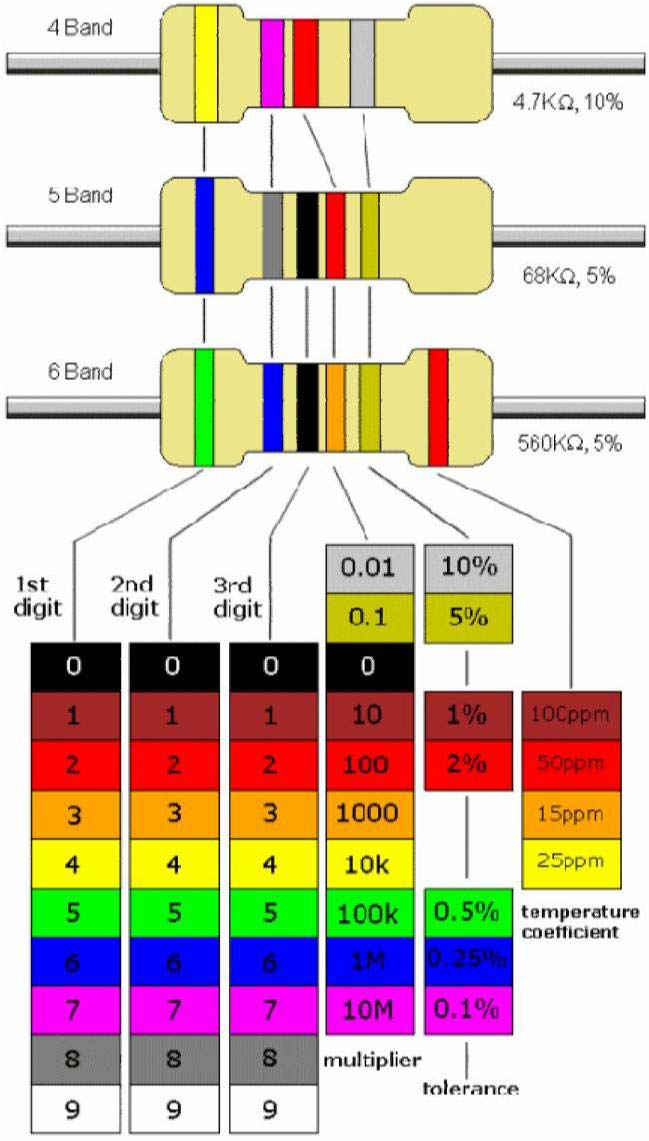
Resistor color code


The color code is read as follows:
1: Start with the band closest to one end of the resistor. The first band is the first digit of the resistance value.
2: The second band is the second digit of the resistance value.
3: The third band is the number of zeros following the second digit, or the multiplier.
4: The fourth band indicates the percent tolerance and is usually gold or silver.


For example, a 5% tolerance means that the actual resistance value is within ±5% of the color-coded value. Thus, a 100Ω resistor with a tolerance of ±5% can have an acceptable range of values from a minimum of 95Ω to a maximum of 105Ω.


Alphanumeric Labeling:-
Two or three digits, and one of the letters R, K, or M are used to identify a resistance value.
The letter is used to indicate the multiplier, and its position is used to indicate decimal point position.


Saturday, 27 September 2014

Voltage, Current and Resistance

Voltage:-

Force of attraction exists between a positive and negative charge.

Certain amount of energy must be exerted, in the form of work, to overcome the force and moves the charges a given distance apart. 
All opposite charges possess a certain potential energy because of the separation between them.
The difference in the potential energy per charge is the potential difference or voltage.  


Definition of voltage:-
V = W / Q
One volt is the potential difference (voltage) between two points when one joule of energy is used to move one coulomb of charge from one point to the other.


Current:-

Current (I) is the amount of charge (Q) that flows past a point in a unit of time (t).

I = Q / t
One ampere is a number of electrons having a total charge of 1 C move through a given cross section in 1 s. 
What is the current if 2 C passes a point in 5 s?      0.4 A

Resistance:-
Resistance is the opposition to current.
One ohm (1 W) is the resistance if one ampere (1 A) is in a material when one volt (1 V) is applied. 
Conductance is the reciprocal of resistance. 
G = 1 / R
Components designed to have a specific amount of resistance are called resistors. 


Friday, 26 September 2014

Electrical Components


Basic electrical components:-
Resistors:
Resistors resist, or limit, electric current in a circuit. The application of resistors are to limit the current, divide voltage, and, in certain cases, to generate heat.

Capacitors:
Capacitors store electrical charges; they are found in most types of electronic circuits.
Capacitor consists of an insulator (dielectric) between two conductors.
The property of capacitor is its ability to block a steady dc voltage while passing ac signals.

Inductors:
Inductors, also known as coils, are used to store energy in an electromagnetic field
When a length of wire is formed into a coil, it becomes a basic inductor. Current through coil produces an electromagnetic field.

Transformers:
Transformers are used to magnetically couple ac voltages from one point in a circuit to another, or to increase or decrease the ac voltage.
A basic transformer is an electrical device constructed of two coils placed in close proximity to each other so that there is a mutual inductance.


Electrical Instruments:-
Power supply: for providing the voltage and current.
Voltmeter: for measuring voltage.
Ammeter: for measuring current.
Ohmmeter: for measuring resistance.
Wattmeter: for measuring power.
(Voltmeter, ammeter, and ohmmeter are available in a single instruments called multimeter)
Oscilloscope: for observing and measuring ac voltages.